Salt Weave
Columbia GSAPP / Core 4 Studio / Spring 2025
Instructor: Mimi Hoang / Studio Partner: Ryan Huang
Design Objective
This architecrure serves not only New Jersey residents intentionally seeking treatment for respiratory and dermatological issues, but also passersby who can passively benefit from the salt-infused air. Through intentional environmental design, salt therapy becomes an ambient experience-naturally occurring, freely accessible, and integrated into daily movement through space. By integrating salt, wind, water, and terracotta, the project transfonns a neglected post-industrial site into a regenerative landscape-promoting public health, ecological diversity, and material experimentation through architectural design.

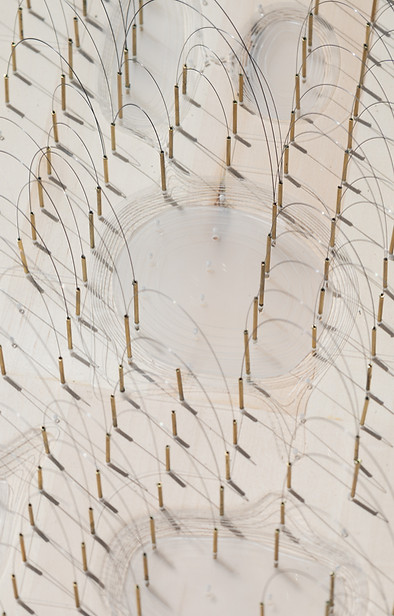
1: 300 model/ wood, acrylic, piano wire, brass dowels

Project Concept
Our project proposes a public health infrastructure, supported by the New Jersey Department of Health and the New Jersey Department of Environmental Protection, that utilizes salt from the Hudson River as both a therapeutic agent and an environmental diagnostic tool. Drawing inspiration from the floating islands of Lake Titicaca- where the Uros people weave totora reeds for buoyancy, privacy, and protection - we adopted the concept of decay and renewal as a central theme. Although the reeds naturally deteriorate, they continuously serve both human and ecological needs, embodying a cyclical process of regeneration.

Site Transformation
This concept parallels the transformation of our site, which has evolved from Indigenous land to an immigrant hub, and now functions as a transit corridor dominated by vehicular traffic. Once a vibrant transportation node, the area is now marked by abandonment and environmental degradation. Industrial development has led to soil and air pollution, contributing to some of the highest asthma rates in New Jersey. Yet amid this decline, nature has reclaimed space. Phragmites thrive where light and water flow through abandoned infrastructure, forming an "accidental wetland"—a hybrid landscape shaped by neglect and resilience. Our project seeks to build upon this phenomenon, transforming the site into a space of human and ecological renewal.


Sketches of Plan & Oblique
The new structure extends from the existing framework, preserving and marking the site's heritage

Spatial Formation Logic
Rotation of the structure to harness dominant wind from northwest
Current State
Adjusted Structure
Adjusted Structure

Gradient of Indoor & Outdoor
Areas with denser arch intersections become more enclosed, creating subtle gradients between indoor and outdoor enviromnents.
These arches fonn a three dimensional scaffold for salt fonnation and environmental engagement.
Embracement of Nature & Existing Condition
Varied beam structures create diverse, interactive spaces. A new system weaves through the existing structure above and below grade. Below, staggered levels collect water of different salinities. Above, terracotta arches harvest salt, channel water, guide wind, and shape spatial transitions. Passive salt crystallization is driven by sunlight, river water, rain, wind, and land changes. The arches support salt formation and environmental engagement. Repurposed train tracks bring river water to inland salt basins, while rainwater is collected and directed to salt pits. The system integrates natural drainage and salt harvesting.


Intwinement of Public & Private
The arches are anchored into existing pipes within the train she dstructure, drawing water upward into the terracotta framework. As salt is absorbed and dried on the surface, it is released into the air via wind funnels created by multiple arch formation.

Spaces of Different Conditions
Overall, the sectional and plan interruptions created as a result of the units repeating and delaying create an eclectic environment where different interior/exterior conditions exist throughout the building. Opening up various opportunities for residents to interact with each other. Additionally, the permeation of the public spaces, plazas positioned in various levels, urban landscape - urban plazas in positioned in different levels throughout the building can be seen in section rior conditions exist throughout the building.
Gradient of Different Salinity Levels
Salt basins have varying salinity levels, which are determined by the number of terracotta-covered columns tapping into the saltwater in each area


Site Impact
This architecture serves not only New Jersey residents intentionally seeking treatment for respiratory and dermatological issues, but also passerby who can passively benefit from the salt-infused air. Through intentional environmental design, salt therapy becomes an ambient experience - naturally accurring


