Layered Living
Columbia GSAPP / Core 3 Studio / Fall 2024
Instructor: Eric Bunge / Studio Partner: Chejin Lee
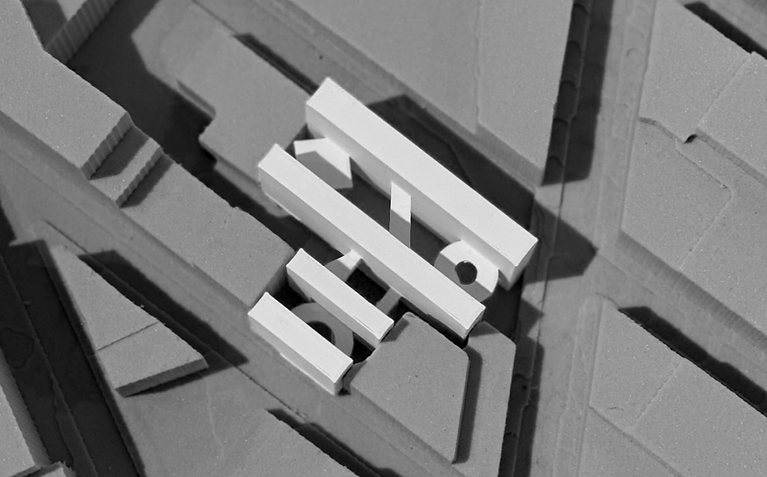
Talent shows and jazz shaped Harlem’s culture, extending into homes as informal performances that built community but challenged privacy. Our design translates this into housing through four interconnected slabs that recreate street-like flows, forming dynamic in-between spaces for interaction and performance.

isometric diagram

plan diagram


Scale 1
Scale 2
Scale 3
Scale 4
Different Scales of Public Spaces
Greenery, which is closely tied to many aspects of the regional society, is sparsely distributed within and around the site. Therefore, our goal is to incorporate more greenery and public spaces that welcome not only residents but also neighbors from the surrounding area, fostering a healthier and more cohesive community.

Structural Reinforcement as a Design Opportunity
Structural reinforcement by differently shaped beams of the intersecting spaces creates various spaces, enabling diverse interactions.
Public & Private

The lower levels, 1st and 2nd floors serve as public space for both the general public and residents where programs such as artist studio, kindergarten, dance and music practice rooms are positioned. The figural connections located on the upper level mirrors to its ground floor, puncturing to each of the slabs. This movement creates this semi-enclosed space to the ground floor programs through its curved out alcove and plazas above functioning as a roof.
Overall, the sectional and plan interruptions created as a result of the units repeating and delaying create an eclectic environment where different interior/exterior conditions exist throughout the building. Opening up various opportunities for residents to interact with each other. Additionally, the permeation of the public spaces, plazas positioned in various levels, urban landscape - urban plazas in positioned in different levels throughout the building can be seen in section rior conditions exist throughout the building.
Spaces of Different Conditions

Plaza Figures As Both a Stage And Connection
Plazas above cast shadows below, creating a sense of an enclosed space at the ground floor

Section Perspective
The permeation of the public spaces in different levels throughout the building, plazas positioned in various levels

Spatial Organization Design
The design uses a grid system for efficient, livable units. A core anchors single-loaded corridors, with units arranged by strip to maximize interaction. Alcoves extend social spaces beyond plaza floors, while select plazas and openings bring sunlight into southern strips. These plazas shape unit layouts, creating varied spatial experiences, with resident facilities clustered nearby to activate them as social hubs.

Juxtaposition of Public and Private
Openings such as sliding doors offer added flexibility in defining public and private spaces, adapting to the residents’ needs.

Alcoves placed in between units act as a gathering space where floors that are not connected to plazas also have a community space

Public and private spaces layered upon each other create a eclectic landscape where people are connected together

The plazas can be a place both for activities and bleachers

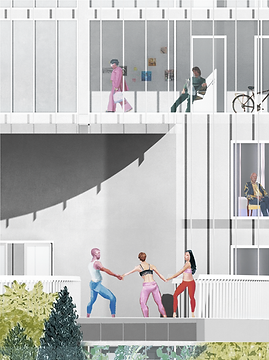

An eclectic array of elevation portrays different layers of public and private juxtaposed onto each other

Weaving of Public Spaces
Public spaces contract and expand throughout and penetrate the strips, creating diverse opportunities for residents to engage and interact with one another